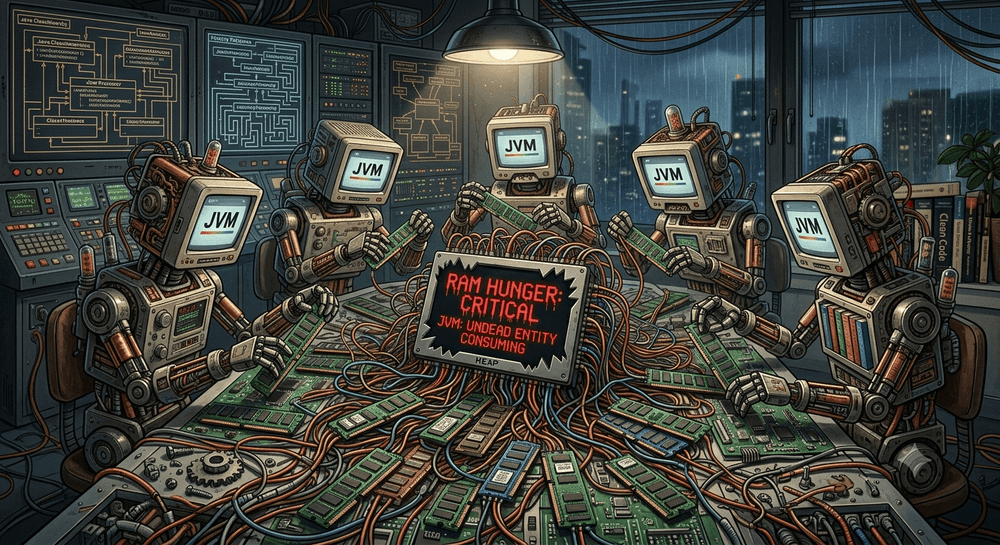
The Living Dead: Why Java Feels So Exhausting Now
Alright, it's 3 AM again. The monitors are still glowing, empty coffee cups litter the desk, and that 'critical' incident is finally, mercifully, 'resolved'. What a night. We just spent six hours chasing a memory leak that turned out to be some 'clever' ORM caching strategy combined with an application server's eager class reloading. Classic. And here we are, staring at another Java application, wondering if it's finally time to pull the plug, metaphorically speaking. You hear people say it, usually half-jokingly, "Java's dead." But after a few rounds in the production trenches, especially when the pager goes off, it starts to sound less like hyperbole and more like a desperate plea.
Let's be clear: Java isn't literally dead. The JVM is still a monumental piece of engineering, a fortress built on decades of optimization. But the language itself, and more importantly, the baggage it carries into battle, feels like a relic. It's the language equivalent of that incredibly reliable, but incredibly fuel-inefficient, diesel truck you just can't get rid of because it always starts, even if it takes five minutes to warm up and chugs through a gallon every mile.
First up, the sheer ceremony. Everything's a class. Everything's an interface, then an implementation, then a factory, then a builder, then a service, then a manager, then a provider, then a repository. Just to instantiate a 'User' object, you've got three files and an XML configuration that nobody's touched in five years. You want a simple data transfer object? Better make sure all your getters and setters are properly generated, your 'equals' and 'hashCode' methods are robust, and for the love of all that's holy, don't forget 'toString' for debugging. Modern languages have record types, data classes, structural typing – things that let you declare "this is just a bag of data" in one line. Java eventually got records, but it feels like showing up to a gunfight with a musket after everyone else has laser rifles.
Then there's the startup time. In a world of ephemeral containers, serverless functions, and rapid auto-scaling, a JVM that takes 30 seconds to warm up and JIT-compile itself into a performant state is a liability. You scale out, and your users hit cold instances, waiting, waiting. "Oh, but the throughput!" they say. Yeah, sure, after the initial traffic spike has already hammered your load balancers and triggered an alert. GraalVM Native Image tries to mitigate this, but it's a whole new layer of complexity to wrestle with, configuration dark magic to get your reflection and proxy frameworks playing nice. It's like putting a rocket engine on that old diesel truck – impressive, but it was probably easier to just buy a new car.
Memory footprint. This is where the JVM really starts to feel its age in containerized environments. You provision 512MB for your microservice, and Java is sitting there, happily consuming 200MB before your first request even hits. Compare that to a Go binary, which might be 20MB. When you're running hundreds of instances, those differences add up. It's not just the heap; it's metaspace, thread stacks, direct buffers. Every little piece of framework magic, every bytecode manipulation, every classloader instance, eats into that precious allocation. And when it does run out, you get that glorious 'OutOfMemoryError' – usually deep in some framework internals, making it practically impossible to pinpoint the actual application code that caused the problem. "No, it's not our fault, Hibernate ate the RAM!"
And let's talk about the frameworks. Spring, Hibernate – they're ecosystems, entire galaxies of abstraction and configuration. They solve huge problems, absolutely. But they also introduce so much indirection, so much 'magic' driven by annotations and bytecodeweaving, that when something goes wrong, debugging becomes an archaeological dig. That 'NoSuchMethodError' might not be because the method doesn't exist, but because some obscure classloader hierarchy in your application server loaded an older version of a dependency that Spring then tried to proxy. Or your 'transactional' annotation didn't actually start a transaction because it wasn't called from a proxied bean. It's like trying to fix a leak in a house where all the pipes are hidden behind seven layers of drywall, and you don't even know which wall the pipes are in.
The 'enterprise' narrative that made Java so dominant for so long is now a millstone. The focus on stability, backward compatibility, and explicit contracts, while valuable, often translates to slow adoption of modern paradigms. While other languages were exploring functional programming, immutability by default, async/await patterns, Java was meticulously adding 'var' and records, catching up rather than leading. The result is a language that often feels overly formal, heavy, and less expressive than its peers, especially for younger developers coming from dynamic languages or Go/Rust. Recruiting for Java roles sometimes feels like you're selling a sensible sedan to someone who wants a sports car – it's reliable, yes, but where's the fun? Where's the excitement of building something truly cutting-edge without battling the language itself
So, is Java truly dead? No, not really. It's undead. It's the zombie in the server room, shambling along, consuming resources, but refusing to lie down. There are millions of lines of Java code out there, powering everything from banking systems to air traffic control. Huge organizations are built on it, and migrating away from it is an engineering effort of monumental proportions, often cost-prohibitive. But for new projects, especially greenfield microservices or anything touching the bleeding edge of cloud-native, you have to seriously question if the perceived "stability" is worth the operational pain, the slower iteration, the memory overhead, and the constant battle against framework complexity. We're not "writing once, running anywhere" anymore; we're "debugging everywhere" because every environment behaves slightly differently with that intricate JVM. The cost isn't just in development hours, it's in the late nights, the stress, the constant patching, and the feeling that you're wrestling with an abstraction layer that's trying harder to be clever than to be simple. Maybe it's time to admit that 'enterprise-grade' often just means 'painfully over-engineered
Continue reading
Beyond the Hype: What 'Advanced JavaScript' Really Means After Midnight
Forget the latest framework. True advanced JavaScript skill is forged in the crucible of production outages, understanding the runtime, and wrestling memory leaks on your first proper JavaScript project.
5 minFrom 500ms to 900ms: How AI-Assisted “Optimizations” Turned a Fast Query into a Slow One — and What Brought It Back to 43ms
An API endpoint went from 500ms to 900ms after AI-suggested “optimizations,” until removing ORM abstraction and switching to raw SQL reduced it to 43ms, revealing how performance depends more on system understanding than generated fixes.
5 min