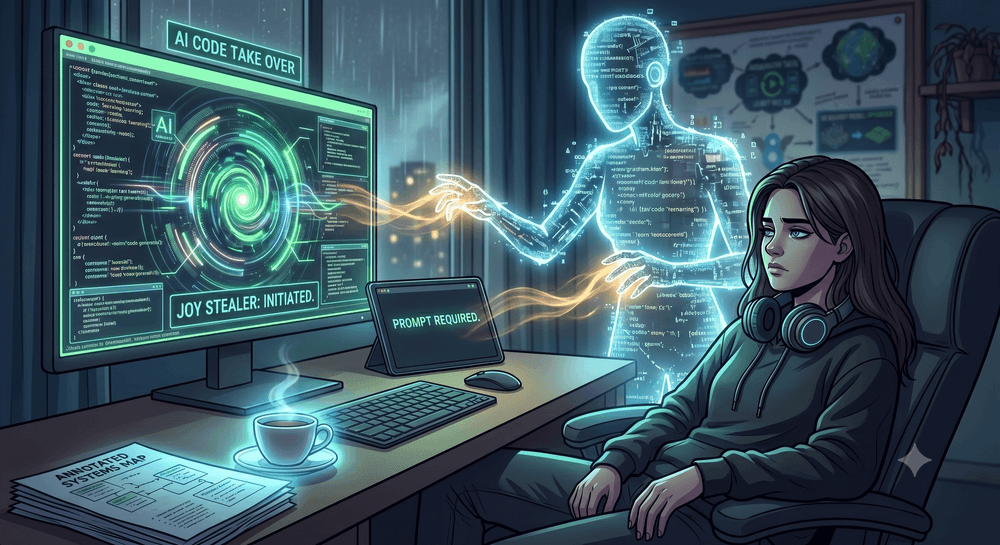
When AI Took the Code, And Left Us Just Poking at the Edges
Remember that first proper gig out of uni? The one where they threw you straight into some ancient, sprawling codebase – maybe PHP 5.3, or a Java 6 Spring monstrosity that looked like it had been through a war? You’d spend weeks, maybe months, just trying to figure out where that elusive 'Invalid Session' error was actually coming from. Not because the logs pointed you to it, because the logs usually just spat out 'Invalid Session' and nothing else useful.
It was a grind. You were digging through stack traces that stretched across a dozen files, setting breakpoints in obscure controller methods, meticulously stepping through lines in a debugger you were still barely comfortable with. You were tracing the data flow, line by excruciating line, trying to mentally map the entire twisted spaghetti from the frontend JavaScript down to the database connection pool. There were late nights, more cold pizza than you care to admit, and plenty of muttered curses under your breath.
But then came that one moment. That specific line, that exact variable state, where you saw the actual bug. A forgotten 'return' statement, a null check that wasn’t quite right, an an off-by-one error in an array lookup that only manifested under specific load conditions. That 'aha!' wasn’t just about fixing the bug; it was a profound, almost visceral download of how the whole damn thing actually fit together. Warts and all. It hurt, sure, but you understood it, truly, deeply. That was the real education, far more than any textbook or lecture. You built an intuition for systems, for failure modes, for the invisible currents running beneath the surface of the code.
Then the AI arrived. And let’s be clear, it’s not all bad. Not by a long shot. It’s undeniably useful for the grunt work, for scaffolding, for getting something on the screen in minutes. It can whip up a 'create-react-app'-level project faster than you can find the npx command online. Need a simple CRUD API with a Postgres backend and a sprinkle of JWT authentication? Give it a prompt, and a minute later, you’ve got a perfectly structured directory, complete with DTOs, service layers, and repository interfaces. All the architectural patterns you’d usually spend half an hour arguing about in a PR comment, just there. Neatly packaged. Almost too neatly.
But that's where the joy starts to bleed out. When you're just a prompt engineer, guiding an incredibly smart autocomplete engine, you're not really writing code in the old sense. You're orchestrating. You're curating. The cognitive load hasn't disappeared; it's just shifted. It used to be about the intricate dance of translating a complex problem into elegant logic, meticulously managing state transitions, optimizing loops for performance. Now, it's about figuring out the right incantation, the perfect prompt, to get the AI to spit out what you think you want. And then, inevitably, you spend the next several hours debugging the subtle, almost imperceptible ways its interpretation of your prompt went sideways.
It’s a different kind of debugging. When you write the bug, you have a mental model of how you got there. You can retrace your steps, understand your own flawed logic. It's a frustrating but ultimately productive self-correction. When the AI introduces a bug, it’s often in a piece of code that looks perfectly plausible, but subtly misunderstands the domain, or makes an assumption about external state that's just plain wrong. It’s an opaque, black-box problem. You’re not debugging your own thought process; you’re trying to infer the 'thought process' of a neural network that doesn't actually 'think' in a human sense. It feels less like solving a puzzle and more like trying to find a specific grain of sand on a vast beach, after someone else scattered it there.
The real issue, I think, is the loss of the craft. The artistry of coding isn't just about functionality; it's about elegance, efficiency, maintainability, and understanding the 'why' behind every choice. AI gives you the 'what' instantly, but it doesn't give you the 'why'. You don't build that muscle memory for problem-solving, that deep intuition for system design, when the heavy lifting is done by an algorithm. You miss the struggle, the dead ends, the small victories of chipping away at a hard problem until it finally yields. Those struggles were where true understanding and skill were forged.
When every new feature starts as a prompt, and every bug fix involves wrestling with generated code, the sense of ownership diminishes. The feeling of truly creating something, of bending the machine to your will with your own ingenuity, starts to fade. We become less like architects and more like highly paid reviewers, constantly validating plausible-looking output. The joy of solving a deeply challenging problem, of tracing that elusive memory leak back to its single unclosed file descriptor in an obscure utility function, the satisfaction of truly understanding down to the bit that flipped – that's what made the long hours worth it. That's what's slowly being abstracted away, leaving us with just… the code. Perfectly formed, often correct, but strangely hollow. We’re left with the task, but less of the journey. And frankly, the journey was often the best damn part of the whole thing.
We’re still writing code, sure. But it feels less like painting a masterpiece and more like curating a gallery of very competent, but ultimately soulless, stock images. The spark, the deeply personal engagement with the machine, that's what seems to be missing. And without that, what are we really doing here, late at night, in front of these glowing screens? Just pushing pixels around until the next deployment, I guess.
Frequently Asked Questions
Is AI making developers redundant?+
Not directly redundant, but it's fundamentally shifting the role. We're moving from hands-on builders to more high-level orchestrators and critical reviewers. The core problems don't disappear, but the way we interact with them and the tools we use to solve them are changing.
What's the biggest loss when using AI for coding?+
The biggest loss is often the deep, intuitive understanding of how complex systems truly work. When AI generates solutions, it bypasses the struggle and the learning process that builds that critical insight, making it harder to debug subtle issues or design robust systems independently.
Can developers still find joy in coding with AI?+
Yes, but the source of that joy changes. It might come from designing high-level architectures, tackling truly novel problems AI can't yet solve, or optimizing AI-generated solutions. The 'joy of crafting' shifts to the 'joy of guiding and refining,' which can still be satisfying, just different.
Continue reading
Claude Code and Your Startup Idea: The Production Debrief
The dream of bootstrapping a business with just an idea and some AI-generated code is potent. The reality, however, is a late-night production debrief, where the shiny facade of LLM-generated solutions meets the cold, hard floor of operational pain.
12 minAI Coding Assistants Fail at Production Debugging
AI coding assistants generate correct-looking code but often fail in production debugging. Learn why runtime profiling, system constraints, and execution paths matter more than generated solutions.
3 min