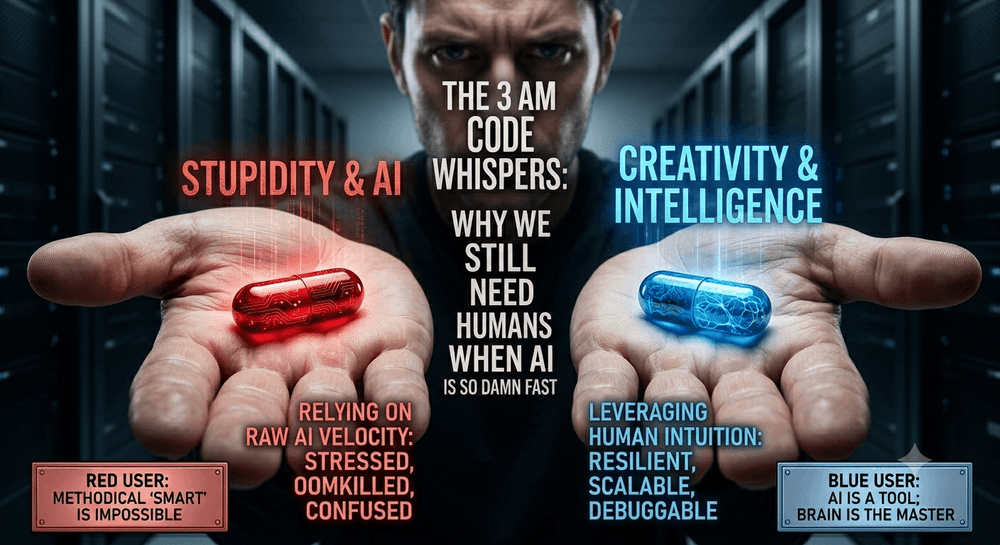
Why We Still Need Humans When AI Is So Damn Fast
We've all been there, haven't we? Staring at a stack trace at 3 AM, eyes gritty, the coffee tasting like defeat, trying to figure out why the 'payment service' suddenly decided to return '503' for 10% of requests. You're not thinking about the elegant design patterns you read about; you're just trying to pinpoint the exact line of code, or the specific 'middleware' component, or the 'database connection pool' setting that decided to give up the ghost. In those moments, the theoretical purity of software engineering evaporates, leaving only the brutal reality of debugging. And it's in those moments, especially now, that the contrast between AI's blistering speed and our own methodical, often painful, human creativity really crystallizes.
Sure, an LLM can churn out 50 lines of 'CRUD' for your new 'User' model in about two seconds. It can generate a dozen 'microservice' architecture diagrams in a minute, complete with 'GraphQL' endpoints and 'Kafka' queues. The sheer velocity of code generation is undeniable, almost seductive, particularly when you're staring down another deadline. It feels like magic, like an infinite supply of junior developers who never sleep, never complain, and always produce something. On the surface, it’s a productivity 'superpower', or whatever buzzword we're using this quarter.
But that speed, that raw generation capability, is mostly about the 'what' and the 'how' – not the 'why', and certainly not the 'when'. When your 'ORM' query suddenly decides to do a full table scan on a production database because someone forgot to add an index to a 'foreign key' constraint, an LLM isn't going to be digging through your 'pg_stat_statements' output at 4 AM, trying to figure out which specific join condition blew up. It won't have the muscle memory to connect that database bottleneck to a recent 'deploy' that changed an API contract, which then subtly altered how a 'backend service' was fetching related data. That's a human connecting the dots: from the PagerDuty alert, through the log aggregation tool, down to the database profiler, and then back up to the Git commit history.
See, AI doesn't understand the years of accumulated technical debt in 'Service X' that makes 'feature Y' an order of magnitude harder than it looks on paper. It doesn't remember that the 'legacy payroll system' integration breaks every full moon because of a 'timezone' issue that nobody has dared to touch since 2017. It operates in a pristine, theoretical vacuum, oblivious to the political battles, the resource constraints, or the sheer historical baggage that underpins every "simple" change. We, the humans, carry that context. We remember the past production disasters that led to the convoluted 'circuit breaker' implementation, or the 'eventual consistency' model that makes perfect sense until a 'network partition' hits and suddenly, accounting is calling.
This isn't to say AI isn't useful. It's fantastic for boilerplate, for generating test cases if you give it pristine requirements, or for drafting a quick 'README' file. It can be a very fast junior dev for the easy stuff. But ask it to debug a 'memory leak' in a C++ microservice running in a 'Kubernetes pod' with custom 'kernel modules' on a 'bare-metal' server cluster, where the leak only manifests under specific, high-load conditions after about 72 hours of uptime? Good luck. We're the ones who will be sifting through 'perf' output, 'strace' logs, and 'valgrind' reports, correlating weird 'kernel panics' with application behavior.
That "gut feeling" that the new 'microservice' architecture, shiny as it looks on the AI-generated diagram, is going to introduce more 'latency' and 'distributed transaction' hell than it solves for your current load profile? That's human. That's earned through years of watching 'premature microservices' turn into 'distributed monoliths' that are impossible to reason about. The decision to not implement the "perfect" solution because the business needs a "good enough for now" solution that ships next week, understanding the long-term trade-offs and the acceptable level of technical debt – that's a human call. It’s about knowing when to optimize, when to abstract, and crucially, when to just get the damn thing out the door.
Our creativity isn't just about generating novel ideas; it's about the ability to synthesize disparate, messy, incomplete information, infer underlying causes, predict downstream effects, and navigate constraints that aren't purely logical. It's about knowing when to apply the hammer, and when to use the scalpel. AI doesn't have the scars from that one time 'Redis' went down and took half the app with it, or the panic from that 'middleware' bug that dropped 5% of all incoming requests. Those scars inform our judgment, our prioritization, and our understanding of what truly matters when the chips are down. Speed is great, but context, intuition, and the hard-won experience of pulling systems back from the brink, those are still uniquely ours. And frankly, that's why we're still here, bleary-eyed, fixing things long after the AI has gone to 'sleep'.
Frequently Asked Questions
Will AI replace software developers?+
AI is not replacing developers; it is changing their role. In 2026, AI handles boilerplate and repetitive tasks, shifting the developer's value toward architecture, system design, and decision-making. The demand is shifting from "coders" to "orchestrators" who can integrate AI agents and maintain complex, resilient systems.
What is the main limitation of using AI for system architecture?+
AI operates in a theoretical vacuum and does not account for the "historical baggage" or accumulated technical debt that makes specific features harder to implement than they appear. AI-generated diagrams often look impressive but fail to foresee practical consequences, such as increased latency or distributed transaction complications that experienced humans recognize through "gut feeling".
What tasks are actually appropriate for AI-assisted development?+
AI is highly effective for generating boilerplate code, such as CRUD models, or drafting routine documentation like README files. It serves well as a rapid junior developer for tasks with pristine requirements and clear, non-complex constraints.
Why does "experience" matter more than raw speed in engineering?+
Experience—referred to as "scars"—informs a developer's judgment on when to prioritize a "good enough" solution over a "perfect" one to meet business needs. Human creativity involves synthesizing messy, incomplete information and knowing when to use specific tools (like a hammer or a scalpel) based on past disasters, which AI has not personally experienced.