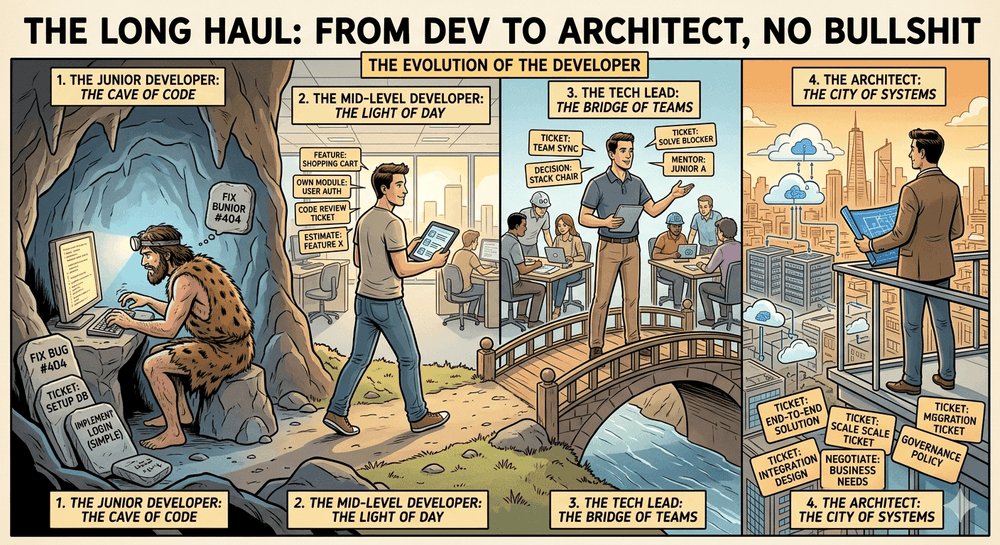
The Long Haul: From Dev to Architect, No Bullshit
Alright, so we've just spent the last six hours untangling that Kafka consumer group rebalance issue that somehow cascaded into database deadlocks, and you're asking about 'career progression.' Good timing, because that whole mess is precisely the difference between just shipping code and actually owning a system. This isn't about some LinkedIn-optimized journey; it's about the shifts in perspective that keep the pager quiet at 3 AM. Or at least, help you figure out why it's screaming. From an architect's chair, the view changes significantly, and what matters for each step up isn't what some HR slideshow tells you. It's about what you actually do and what you actually understand.
The Jump From Junior: Beyond 'It Works On My Machine'
When you're junior, your main goal is to get the thing working. You're learning the codebase, maybe wrestling with your IDE, figuring out how a Git rebase actually works without screwing up the team's history. You're focused on the if statements and the for loops. Good, that's foundational.
To move to mid-level, you need to broaden that lens. It's not just 'does it work?', but 'does it work reliably? Is it understandable?'. You start to care about the next person who reads your code – maybe it's you in six months, trying to debug a feature you wrote after a three-day hackathon. You're expected to take a feature, understand its requirements (not just the technical ones, but the why), and deliver it mostly independently. You're troubleshooting errors beyond simple typos, actually debugging a stack trace, rather than just restarting the service and hoping. You start thinking about tests, even if they're just basic unit tests, because you've seen what happens when you don't. The shift here is from being told what to do and often how to do it, to being given a problem and being expected to find a decent solution on your own. You become a reliable producer, not just a learner. You learn the cost of a bad commit, and the joy of a well-defined interface. You start to see how your small piece of code fits into the immediate surrounding components. Not the whole system, just the immediate neighborhood.
Mid-Level to Senior: From Components to Systems
Okay, so you're a mid-level dev. You can ship features, you know the codebase, you're a solid contributor. Now, the jump to senior is where things get interesting, and frankly, where most people stall if they don't consciously shift gears. A senior engineer isn't just a mid-level engineer who's been around longer and writes more code. That's a myth.
As a senior, you're expected to understand the system. Not just your service, but how it interacts with the database, the caching layer, the message queues, the authentication provider, and whatever legacy monstrosity is lurking in the corner. You're thinking about performance, scalability, and resilience before you write the first line of code. You've been burned enough times by a seemingly innocuous change that took down half the platform. So, you start asking questions like: 'What's the blast radius of this change?' 'What happens if this dependency is slow or fails?' 'How do we monitor this properly?'
Seniors also mentor. This isn't just code reviews where you point out a missing semicolon. It's about teaching patterns, explaining why certain architectural decisions were made, and helping juniors untangle complex problems without just giving them the answer. You're a force multiplier. You're also deeply involved in design discussions, weighing trade-offs – build vs. buy, synchronous vs. asynchronous, SQL vs. NoSQL – not just from a 'can we do it?' perspective, but from a 'should we do it, and what's the long-term cost?' perspective. You identify problems before they hit the backlog, often by just looking at the tea leaves of production metrics or sniffing out technical debt that's about to explode. You own entire services or critical components, becoming the go-to person for their health and evolution.
Senior to Architect: Seeing the Horizon (and the Icebergs)
This is where my world lives. Moving from senior to architect is less about writing code (though you still need to be able to, and often do, to stay sharp and credible) and more about shaping the future of the platform. You're not just thinking about a system, but the entire ecosystem of systems. You're thinking years ahead, not just the next sprint or quarter. You're sketching diagrams on whiteboards (or in Excalidraw, if we're being modern) that connect disparate services, outline data flows, and define interaction patterns.
The architect's job is about vision, strategy, and massive trade-off management. You're looking at the business goals and translating them into a coherent technical roadmap. You're assessing new technologies, not just if they're cool, but if they actually solve a problem for our specific context, and what the operational overhead will be. Most new tech is just a shiny distraction. You need to know which 5% isn't.
Communication becomes paramount. You're talking to product managers about technical feasibility and cost, to other architects about integration points, to senior leadership about strategic investments, and to engineers about the 'why' behind the high-level designs. You're an evangelist for sound principles, a diplomat when teams clash over ownership, and sometimes, the bad cop who says 'no' to a pet project that would just create more operational pain down the line. You're defining the guardrails, the architectural patterns, and the engineering principles that guide everyone else's work. You're obsessed with reducing complexity, because complexity is what screams at 3 AM. Your primary output isn't code; it's clarity, direction, and a robust framework within which others can build efficiently and reliably. It's about ensuring the ship stays afloat and sails toward the right destination, even when a storm hits.
Each step up isn't about doing more of the same thing. It's about a fundamental change in scope, responsibility, and the kind of problems you choose to solve. It's about widening your aperture, from the single line of code, to the component, to the system, and ultimately, to the entire technical landscape of the business. And it's always, always, about preventing that damn pager from going off.
Frequently Asked Questions
What's the most important mindset shift from junior to mid-level?+
Stopping to think about blast radius. A junior ships code that works. A mid-level engineer starts asking what breaks downstream when that code misbehaves under real load — and designs around that before it happens
How do you know you're ready for a senior role?+
When you stop asking 'how do I build this' and start asking 'should we build this at all, and what happens to the system in two years if we do.' Seniority is pattern recognition built from enough production fires to know which shortcuts become incidents
Is switching frameworks and learning new tools the path to seniority?+
Not really. Tools are surface area. What actually compounds is understanding why systems fail, how to reason about trade-offs under pressure, and how to make decisions that don't create a worse problem six months later